
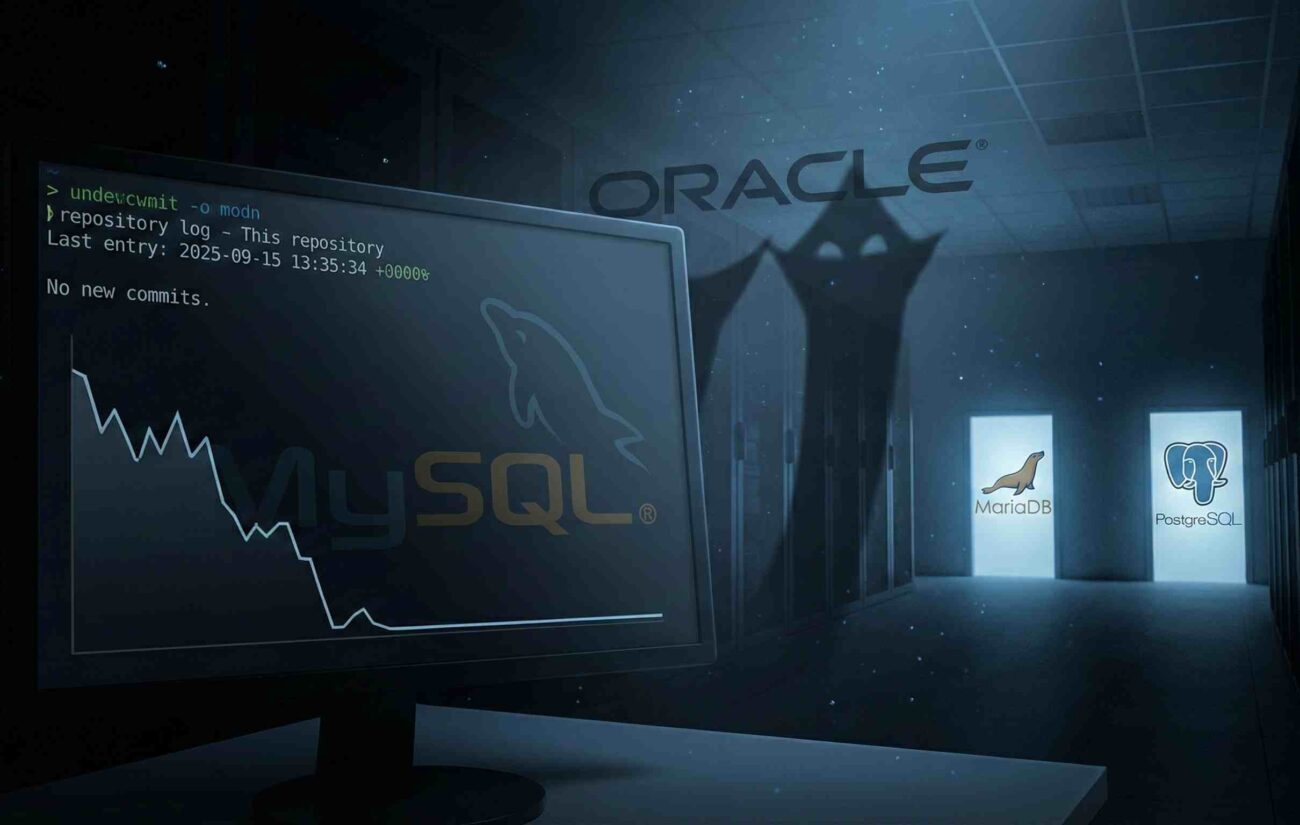
In the fast-moving world of open-source software, silence is rarely a good sign. For MySQL, one of the world’s most popular database management systems, that silence has become deafening. As of January 2026, the official open-source MySQL repository has seen no new commits for over three months, a stillness that has sparked concern, speculation, and frustration across the developer community.
For a project that powers a massive chunk of the internet, this unprecedented halt raises a critical question: Is this the end of MySQL as we know it?
The Data Doesn’t Lie
The last recorded commit to the MySQL repository dates back to September 2025. While commit volume often fluctuates in large projects, a complete freeze of this duration is unheard of for a database of MySQL’s caliber.
This isn’t just a momentary blip; it appears to be the nadir of a long-term trend. Data analysis reveals that commit activity has been steadily declining since 2019. By the end of 2025, the project hit its lowest activity levels since the early 2000s. The graph, once vibrant with daily updates and community contributions, has flatlined.
Why Did It Happen? The Oracle Factor
The primary catalyst appears to be internal shifts at Oracle, the steward of MySQL. Reports indicate that the MySQL team has been hit by significant layoffs, gutting the workforce responsible for maintaining the open-source codebase.
However, this looks like more than just cost-cutting. Industry analysts suggest a strategic pivot is in play. Oracle seems to be aggressively prioritizing its proprietary and cloud-based offerings—specifically MySQL Enterprise Edition and the cloud-hosted MySQL HeatWave. The resources and talent that once flowed into the community edition are arguably being redirected to these revenue-generating products, leaving the free, open-source version to wither.
“Open Source Only by License”
The community reaction has been swift and critical. Long-time observers are noting that MySQL has been drifting away from the ethos of open source for years.
Otto Kekäläinen, a prominent figure in the database community, recently described MySQL as being “open source only by license, but not as a project.” The distinction is vital: while the code remains technically free to use under the GPL, the collaborative spirit—the governance, the external contributions, and the transparency—has evaporated. Unlike PostgreSQL, which thrives on a diverse, community-driven ecosystem, MySQL has become increasingly insular, controlled entirely by the whims of a single corporate entity.
What Should Developers Do?
For CTOs, architects, and developers, this uncertainty is a major risk factor. Relying on a database with a stagnant codebase means missing out on security patches, performance improvements, and modern features.
If you are currently running MySQL Community Edition, it might be time to evaluate your roadmap. Two clear alternatives have emerged as the standard-bearers for the future:
- MariaDB: Created by the original founders of MySQL as a “fork” to ensure it remained free, MariaDB is the closest drop-in replacement. It is governed by a foundation and remains true to open-source principles.
- PostgreSQL: Often considered the gold standard for modern open-source relational databases, “Postgres” boasts a vibrant, independent community and a technical feature set that rivals expensive proprietary systems.
