
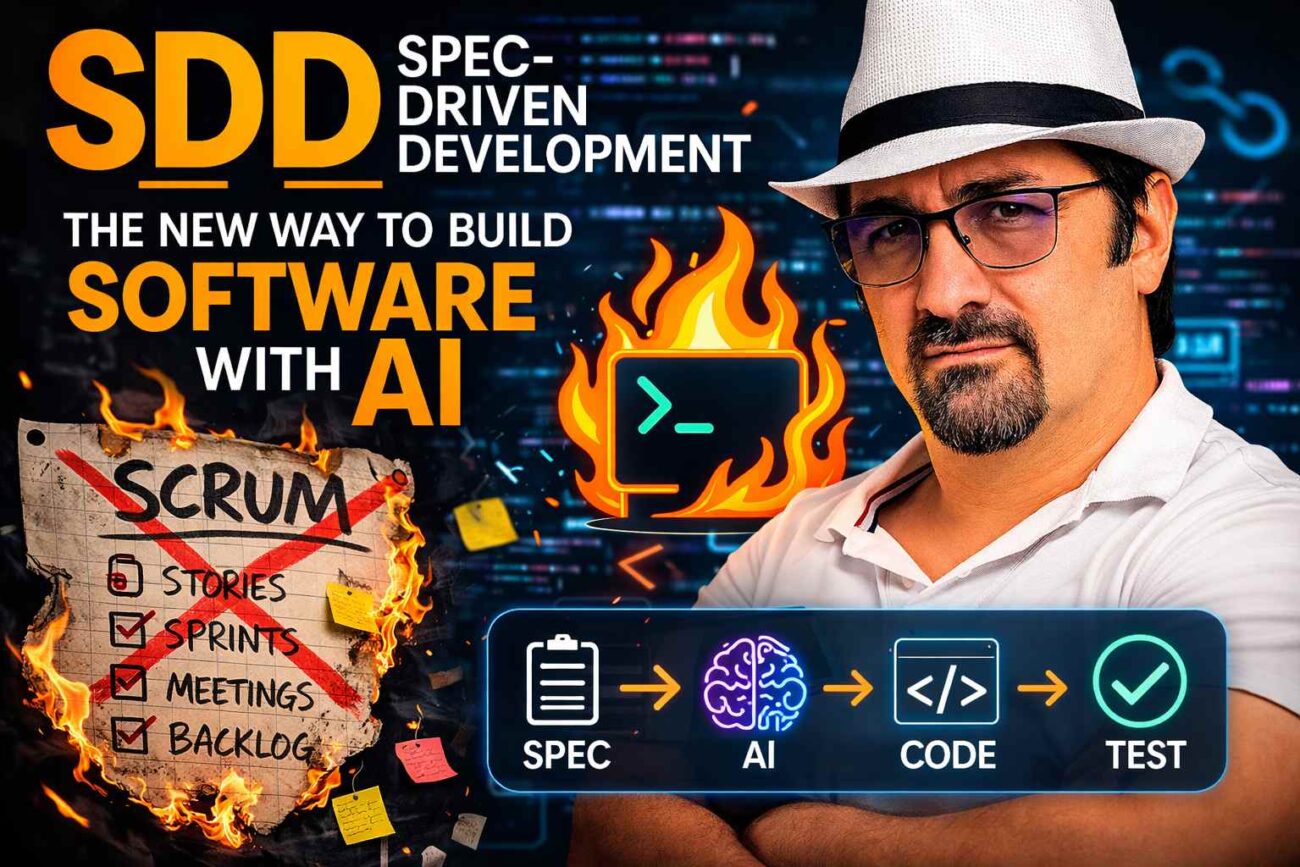
For more than two decades, software teams organized themselves around frameworks like Scrum and other agile methodologies. These approaches helped developers coordinate work, ship incrementally, and manage complexity when software delivery was slow and expensive.
But something fundamental has changed. With the rise of AI-assisted development tools, the cost of writing code has dropped dramatically. As a result, a new development paradigm is emerging across engineering teams: Specification-Driven Development (SDD).
In this model, the primary artifact of software development is no longer code.
It’s the specification.
From Code-First to Spec-First
Traditionally, the development workflow looked something like this:
- Product defines requirements.
- Developers implement the code.
- QA validates the implementation.
- Documentation follows.
In practice, code became the source of truth, and documentation often lagged behind.
AI changes that dynamic. Modern AI development tools can generate large portions of working code, tests, and documentation. But to do that effectively, they require clear, structured instructions.
That’s where SDD enters the picture. Instead of writing code first, we now start with a structured specification that defines:
- Functional requirements
- Data structures
- APIs and interfaces
- Constraints and edge cases
- Acceptance tests
Once the specification is defined, AI tools can implement large parts of the system automatically.
In other words: Specification → AI → Code
The New Human-AI Development Loop
AI does not replace engineers (for now), instead, it changes the workflow.
A typical SDD workflow looks like this:
- Humans define the specification
- Product requirements
- User stories
- technical constraints
- AI proposes a technical plan
- architecture suggestions
- component breakdown
- implementation strategy
- Humans review and refine the plan
- AI generates the implementation
- code
- tests
- documentation
- Humans validate and iterate
The development cycle becomes a human–AI feedback loop, where humans guide the system and AI performs much of the mechanical implementation work.
Why This Works So Well with AI
Large language models perform best when the problem space is well defined.
Vague prompts produce inconsistent results.
Clear specifications produce reliable implementations.
A structured spec file (often written in Markdown) acts as a contract between humans and AI.
For example:
Feature: Password Reset

Requirements:
- Users can request password reset via email
- Reset tokens expire after 15 minutes
- Tokens can be used only once

Acceptance Criteria:
- Expired tokens return error
- Reused tokens are rejected
- Email must be verified before reset
The spec becomes the control layer for AI-generated software.
The Delivery Bottleneck Is Gone
Historically, software teams spent most of their time on writing and shipping code.
AI is rapidly compressing that phase. Tasks that once took hours now take minutes:
As delivery becomes cheaper and faster, the bottleneck shifts to Discovery where teams determine:
- what problems users actually have
- what product features solve those problems
- what solutions create real business value
AI can help analyze data and accelerate research, but it still struggles with:
- strategic judgment
- user empathy
- product intuition
- market understanding
That means the human role shifts upstream. Developers increasingly act as:
- system architects
- product thinkers
- spec designers
- AI orchestrators
Coding becomes less scarce. Clear thinking becomes more valuable.
Smaller Teams, Bigger Output
Another effect of AI-assisted development is team compression.
A single engineer working with AI tools can produce significantly more output than before.
This allows smaller teams to build products that once required larger organizations.
Some early-stage startups are already operating with teams of three or four engineers that previously might have required seven or eight.
However, this doesn’t eliminate the need for expertise. AI amplifies engineers, it doesn’t replace them.
Specification-Driven Development has one major caveat: Bad specifications generate bad systems faster.
When AI accelerates development, it also accelerates mistakes. In an AI-driven workflow, the quality of the specification becomes critical.
The biggest change introduced by AI is not faster coding, it is a shift in what matters most in software development.For decades, the main artifact of engineering was source code. In an AI-assisted world, the main artifact becomes the specification.
The competitive advantage may no longer belong to the fastest coders. It will belong to the teams that think the clearest about what they want to build and then let AI build it.
