
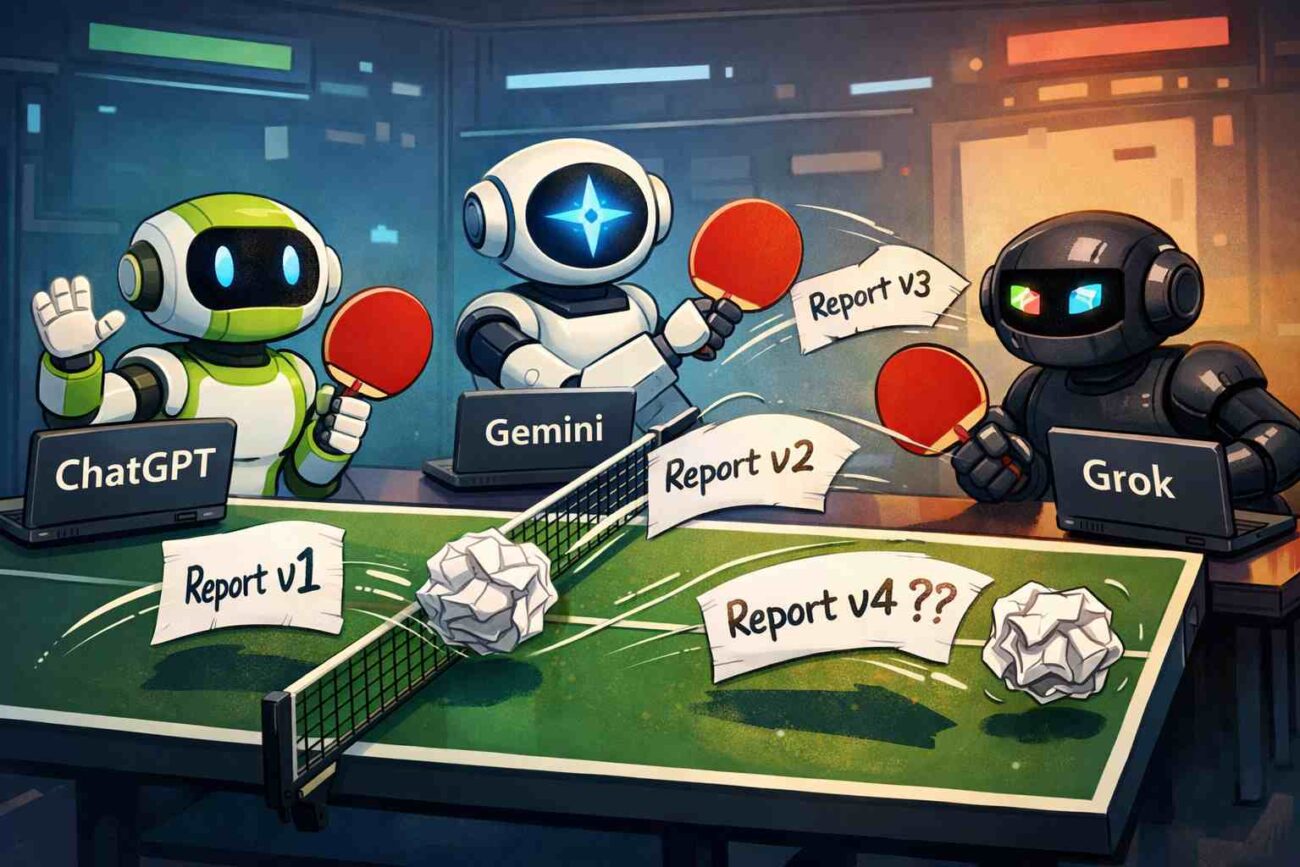
Why Using More AI Models Can Make Your Writing Worse
In the past year a curious workflow has appeared across tech companies, startups, and even hospitals.
Someone writes a report using ChatGPT. Then they paste it into Gemini and ask: “make it better.”
The result goes to Grok with the same instruction. Sometimes it eventually returns to ChatGPT for another rewrite.
The process looks something like this:
ChatGPT → Gemini → Grok → ChatGPT
At first glance, this feels like a smart idea. If one AI can improve a document, then multiple AIs should refine it even further.
But in practice, this workflow often degrades the quality of the document instead of improving it.
Welcome to the AI Ping-Pong Trap.
Why the Workflow Feels Like It Works
After several passes, the text often looks better.
Sentences are smoother.
Grammar is cleaner.
Transitions feel more professional.
This creates the illusion of improvement. But most of these changes are cosmetic, not substantive. The models are mostly rearranging phrasing rather than improving the underlying content.
The writing becomes more polished but not necessarily more accurate or more insightful.
The Hidden Problem: Information Drift
Every large language model has its own stylistic patterns and preferences.
When multiple models rewrite the same document repeatedly, subtle changes begin to accumulate:
- technical terminology may be simplified
- qualifiers and caveats can disappear
- precise wording may become generalized
- important nuances can be lost
This phenomenon is similar to repeatedly compressing an image file. Each save slightly degrades the signal until the original detail starts to disappear.
In technical writing, these small shifts matter. A security report, medical note, or engineering document can slowly lose precision.
The “AI Tone” Effect
Another side effect appears after several rounds of rewriting: style convergence.
Large language models tend to smooth language into a particular neutral style. After enough rewrites, many documents develop the recognizable tone of generic AI output:
- polished
- neutral
- slightly verbose
- technically less precise
For marketing copy this may be acceptable. For engineering documentation or vulnerability reports, it can be dangerous.
Precision matters more than smoothness.
Why People Still Do It
Despite its flaws, AI ping-pong editing has become surprisingly common.
There are several reasons:
Psychological safety
People trust the result more when multiple systems review it.
Grammar improvements
Repeated rewriting can fix awkward phrasing.
Curiosity
Users enjoy seeing how different models reinterpret the same text.
For non-native English speakers, the workflow can genuinely help improve readability. But it remains an inefficient editing strategy.
A Better Way to Use AI for Editing
Instead of bouncing a document between different models, use structured editing prompts.
For example:
First pass: clarity
Improve grammar and readability without changing technical meaning.
Second pass: structure
Reorganize the document with headings and logical sections.
Third pass: conciseness
Reduce the text by 20% while preserving all key information.
Fourth pass: critical review
Identify ambiguous claims or unsupported statements.
Each step defines a clear objective. The AI performs targeted improvements rather than vague rewrites.
The Real Skill of the AI Era
Many users assume the future of AI productivity will be about choosing the best model.
In reality, the real advantage comes from something simpler: knowing how to ask the right question.
One precise prompt will often produce a better result than sending the same text through five different models with the instruction “make it better.”
