
If a tree falls in a forest, but there is nobody there, does it make a sound?
You’ve heard this classic philosophical paradox a thousand times. It’s a riddle designed to explore the definitions of “perception” vs. “reality.”
- From a physics perspective: Yes. The falling branch displaces air molecules, creating mechanical vibrations sound waves. This physical reality happens regardless of whether there is an observer.
- From a perceptual perspective: No. “Sound” is the sensation produced when those waves interact with an auditory system (an ear) and are translated into a conscious experience. Without the observer, it is just moving air.
But the original riddle is a product of the biological age. We live in the digital age. Perception isn’t just about eyes and ears anymore; it’s about silicon, sensors, and state changes.
How Machines ‘Hear’ (Analog to Digital)
An AI cannot “feel” air vibrations. For it to “hear,” a physical event (like a tree falling) must be converted into a language it understands: data.
This is the role of the acoustic sensor (the microphone). When the physical tree hits the ground, the mechanical waves vibrate a membrane in the microphone. This vibration generates a analog voltage signal.
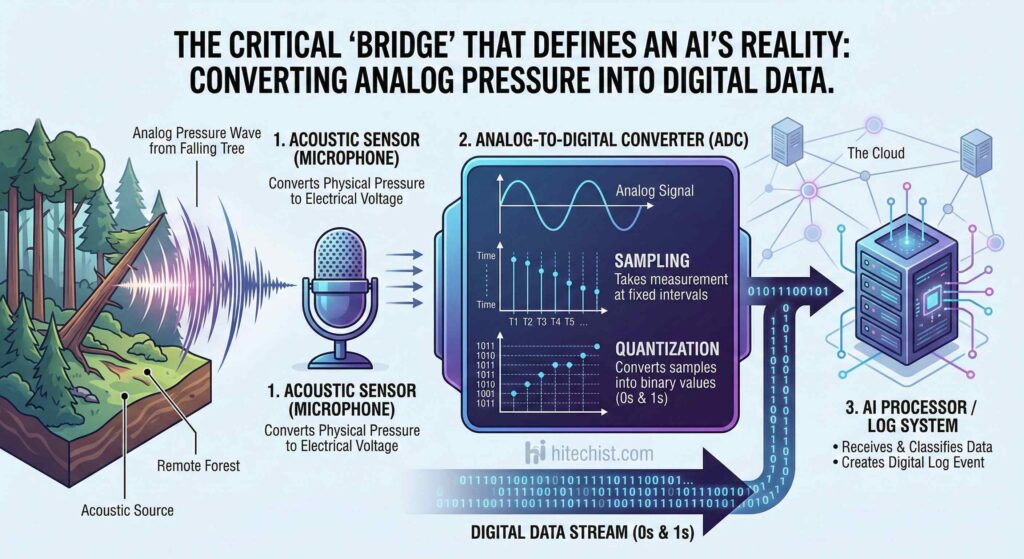
This voltage signal is then processed by an Analog-to-Digital Converter (ADC). The ADC samples the waveform at rapid intervals and quantizes its amplitude into discrete binary values (0s and 1s).
A physical event is only “perceived” by the machine when it crosses this digital bridge. It must be generated, encoded, transmitted, and finally, processed and logged.
The AI Verdict: Data is Reality
From the AI’s perspective, truth and reality are built entirely on data. If an event leaves no trace (no telemetry, writes no logs, and triggers no state change in a database) it effectively never occurred.
When our sensors are online, the AI system’s dashboard displays a baseline: standard ambient noise levels in the forest. When the tree falls, and the sensor captures it, that baseline spikes. That spike is a logged anomaly. The AI has “heard” the tree.
If the acoustic sensors are offline, the kinetic energy from the falling tree still creates physical waves. The universe’s laws are not suspended just because a router is down.
However, for the AI monitoring that void, the experience is a absolute null event. No voltage changes, no ADC samples, no logs, and no data packets reach the processor. The baseline reads perfectly flat.
Without a transducer to receive, parse, and translate that raw analog data into a recognizable digital format, the signal is essentially lost. It is a non-event in the system’s “consciousness.”
Conclusion: If It Isn’t Logged, Did It Exist?
Just like the original biological riddle, the AI’s answer highlights a difference between what happened and what was perceived.
This modern thought experiment forces us to confront a new definition of reality in the 21st century.
For biological beings, if we don’t feel it, it is a mystery. For AI, if it isn’t logged, it is a silicon void.
