
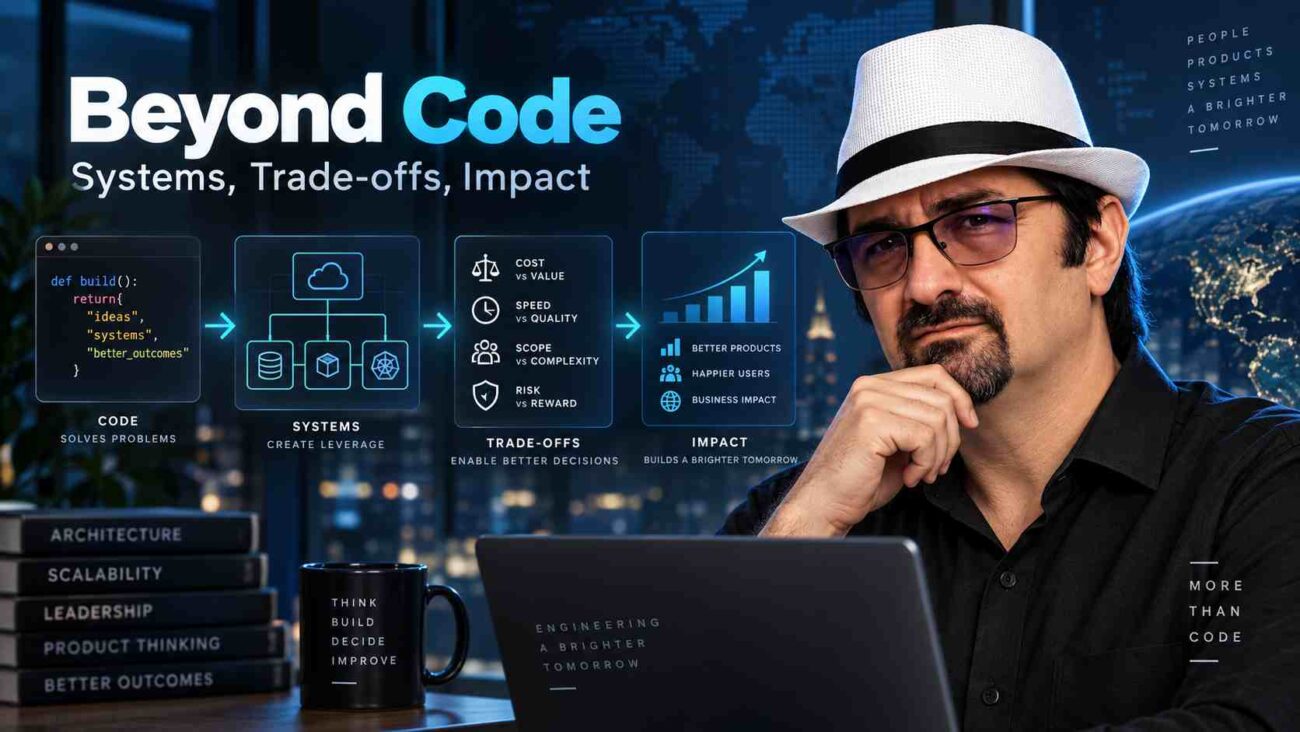
For years, many developers assume that becoming a better engineer means writing cleaner code, learning more frameworks, and mastering increasingly complex technologies.
That matters. But it is not what separates senior engineers from everyone else.
The real shift happens when you stop optimizing for code and start optimizing for systems, trade-offs, and impact.
A good example is Kubernetes.
Kubernetes is powerful, flexible, and battle-tested. It is also operationally expensive. For a small team, adopting it can easily create more problems than it solves: infrastructure overhead, maintenance, specialized knowledge, and additional failure modes.
The same applies to architecture. Engineers often design for an imaginary future: millions of users, massive traffic, global scale.
Designing today for problems you may have five years from now usually means paying the complexity tax immediately, without receiving any of the benefits.
Good engineering is not ignoring the future. It is designing for the next realistic stage.
A simple client-server architecture with a database can go much further than many developers expect. Complexity should be introduced when reality demands it, not when a diagram looks more impressive with another box.
A small change in one service can increase load somewhere else, amplify retries, increase latency, or trigger cascading failures. Mature engineers think about the entire system and assume that components will eventually fail.
Technical decisions must connect to business outcomes. Lower latency matters only if users notice it. Higher availability matters because downtime costs money, trust, or customers. A database migration is not valuable because the new database is technically elegant. It is valuable if it solves a real constraint.
That is the difference between implementing technology and engineering a product. As AI makes writing code faster and cheaper, this distinction will become even more important. The scarce skill will not be producing syntax.
The best engineers are not the ones who use the most advanced tools but the ones who know when those tools are actually necessary.
