

Linux 7.3 is shaping up to be one of the more performance-focused kernel releases in recent memory. The gains are not coming from one headline feature, but from a broad set of improvements across filesystems, scheduling, memory management, and real-time latency.
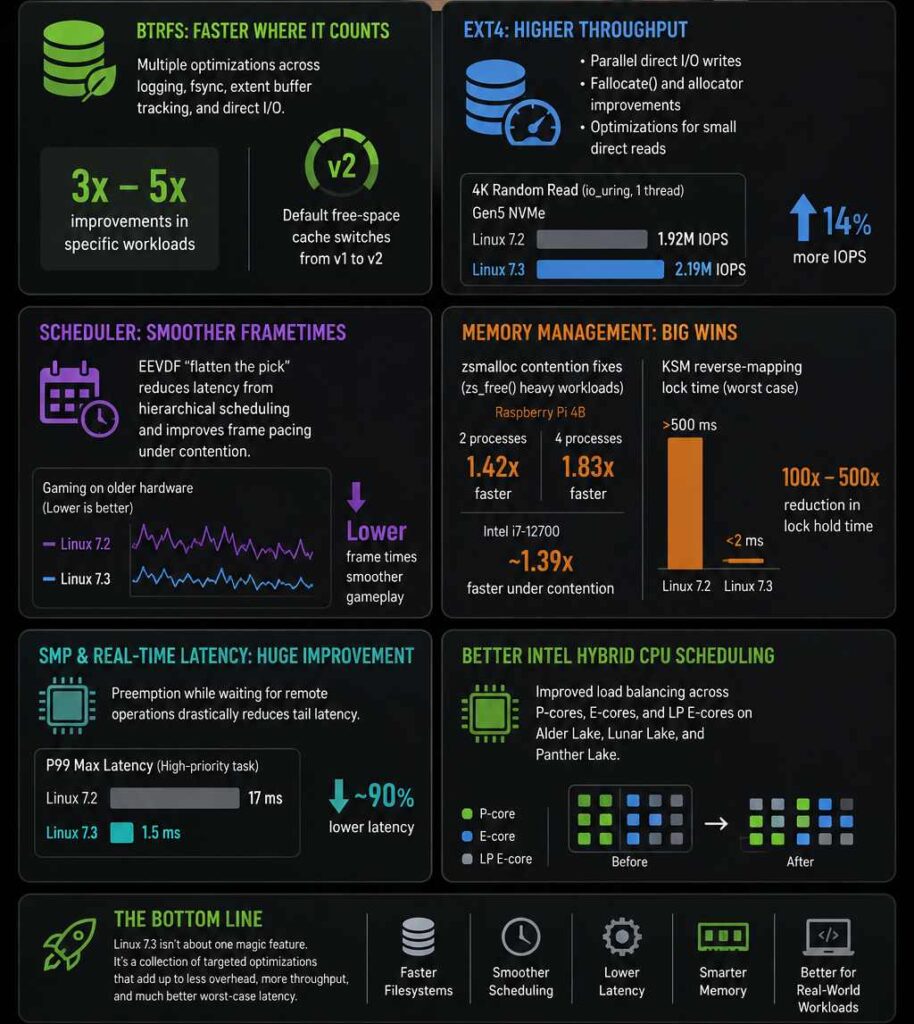
Btrfs is getting some of the biggest changes. Several hot paths around logging, fsync, extent-buffer tracking, and direct I/O have been optimized, with some targeted workloads showing gains in the 3x to 5x range. Those numbers should not be interpreted as a universal Btrfs speedup, but they show how much overhead has been removed from specific operations. The old free-space cache v1 is also giving way to the more modern v2 implementation by default.
EXT4 is improving as well. Parallel direct-I/O writes reduce serialization, allocator work improves fallocate() behavior, and optimizations around small direct reads can significantly increase IOPS on very fast storage. One upstream benchmark on Gen5 NVMe increased from roughly 1.92 million to 2.19 million IOPS in a highly optimized 4K random-read workload.
The scheduler may be even more interesting for desktop users. Changes to Linux’s EEVDF scheduling logic reduce latency caused by hierarchical task selection, improving frame pacing when systems are under contention. Testing on older hardware showed noticeably smoother gaming behavior, suggesting that these changes could matter most on lower-end CPUs where scheduling overhead is easier to feel.
Memory management is seeing similarly aggressive cleanup. zsmalloc contention fixes produced gains of around 1.4x to 1.83x in heavily parallel tests, including on Raspberry Pi hardware. KSM received a particularly dramatic locking fix: worst-case reverse-mapping lock hold times in one stress test dropped from more than 500 milliseconds to under 2 milliseconds.
Linux 7.3 also improves SMP tail latency. Changes allowing preemption while waiting for remote CPU operations reduced P99 latency in reported measurements from around 17ms to 1.5ms, a major improvement for DPDK, networking, and other latency-sensitive workloads.
Intel hybrid CPUs benefit too, with better scheduling decisions across P-cores, E-cores, and newer low-power core configurations on platforms including Alder Lake, Lunar Lake, and Panther Lake.
None of this means Linux 7.3 will make every system dramatically faster. Many of the largest numbers come from carefully targeted benchmarks. But taken together, the release contains an unusually dense collection of optimizations aimed at throughput, contention, frame-time consistency, and worst-case latency.
That makes Linux 7.3 a kernel release worth watching for performance enthusiasts. Not because of one miracle patch, but because performance work is happening almost everywhere at once.
