
Living off the Land
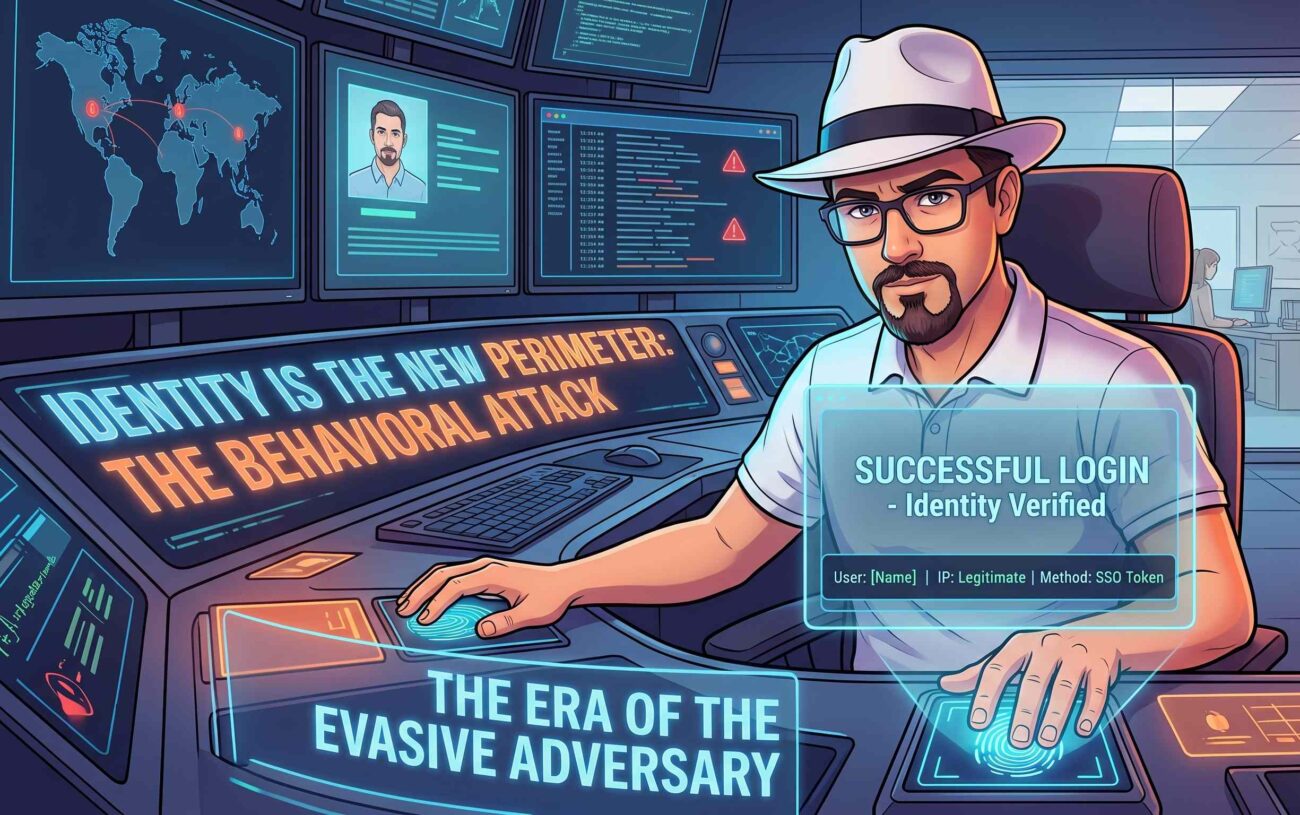
If you checked your security logs today and saw a successful login from a legitimate IP address, you probably wouldn’t raise an alert. And that is exactly what modern threat actors are counting on.
As we navigate the cybersecurity landscape of 2026, the industry is facing a harsh reality: the biggest mistake an organization can make is no longer failing to detect malware. It is failing to realize that the attacker has already logged in as a trusted user. We have officially transitioned from defending against technical exploits to defending against malicious behavior.
Identity is the New Perimeter
For years, security operations centers (SOCs) were optimized to detect malicious artifacts: an unknown binary, a suspicious payload, or a forced entry. Today, attackers are simply walking through the front door.
A staggering 82% of recent attacks did not use malware. Attackers are relying heavily on valid credentials, leaving zero artifacts behind.
source: https://www.crowdstrike.com/en-us/blog/crowdstrike-2026-global-threat-report-findings
Instead of deploying a Trojan or executing a complex exploit, modern adversaries use a much simpler route: the IT Helpdesk. By using credible pretexts, attackers manipulate standard procedures to reset passwords and re-enroll Multi-Factor Authentication (MFA) devices.
Once inside, they do not need to install persistence mechanisms in the registry. They maintain access through active Single Sign-On (SSO) sessions and SaaS applications. When they move laterally, they use the exact same tools your network administrators use: PowerShell, ssh, RDP, and legitimate APIs. This strategy, known as Living off the Land , makes them practically invisible to traditional endpoint defenses.
The critical window it takes for an attacker to move laterally across a network after an initial compromise (known as the breakout time) has plummeted.
Your traditional triage, validation, and escalation pipeline is simply not designed for aggressive timeframes. If an organization cannot respond at machine speed, the battle is lost before a support ticket is even opened. We are no longer just defending systems; we are defending automated workflows and decisions.
Supply Chain and the Illusion of Trust
To understand how devastating supply chain attacks have become, we only need to look at the massive crypto heist targeting Bybit, which resulted in the loss of 1.46 billion dollars in Ethereum.
The attackers, attributed to the Lazarus Group, did not break the blockchain, crack the cryptography, or compromise the hardware wallets directly. Instead, they compromised the frontend UI of a trusted third-party multisig platform.
When employees initiated a routine transfer, the screen displayed the correct, legitimate details. In reality, the manipulated JavaScript was feeding them a malicious transaction. The victims cryptographically signed away their assets using real hardware wallets, completely unaware. This shattered a major industry belief: trust is no longer a security control; it is an attack surface.
AI as the Chaos Multiplier
Artificial Intelligence is not necessarily creating new tactics, techniques, and procedures (TTPs), but it is drastically reducing the time required to execute them. AI-assisted attacks have surged, acting as an accelerator for the modern adversary.
- Ultra-credible Phishing: Generating flawless, highly targeted social engineering campaigns.
- Automated Discovery: Using embedded prompts to scan and map environments instantly.
- LLM-Driven Malware: Threats that integrate Large Language Models to autonomously adapt and improve data extraction on the fly, rather than relying on static scripts.
The threat landscape is no longer about ransomware operators making a loud entrance and encrypting a single workstation. Today’s actors are compromising Edge devices like Firewalls and VPNs to establish silent, long-term persistence. Even modern ransomware has evolved, shifting to remote encryption via SMB to lock down hypervisors and shared storage without ever executing code on the victim’s endpoint.
The ultimate challenge of 2026 is that modern cyberattacks simulate the absolute normality of your company’s daily operations. Attackers know that if they look like an employee working late, no one will question their activity. The question for the security teams is no longer whether they are under attack, but rather how long it will take them to realize they have already been breached.
