For decades, the defining skill of a software engineer was fluency in syntax. The best developers were those who could translate complex human logic into machine-readable text with minimal errors. Today, that fundamental reality is shifting beneath our feet.
As artificial intelligence moves from novelty to necessity, the modern programmer is no longer just a writer of code; they are becoming an editor, an auditor, and a system orchestrator.
The Three Eras of AI Coding
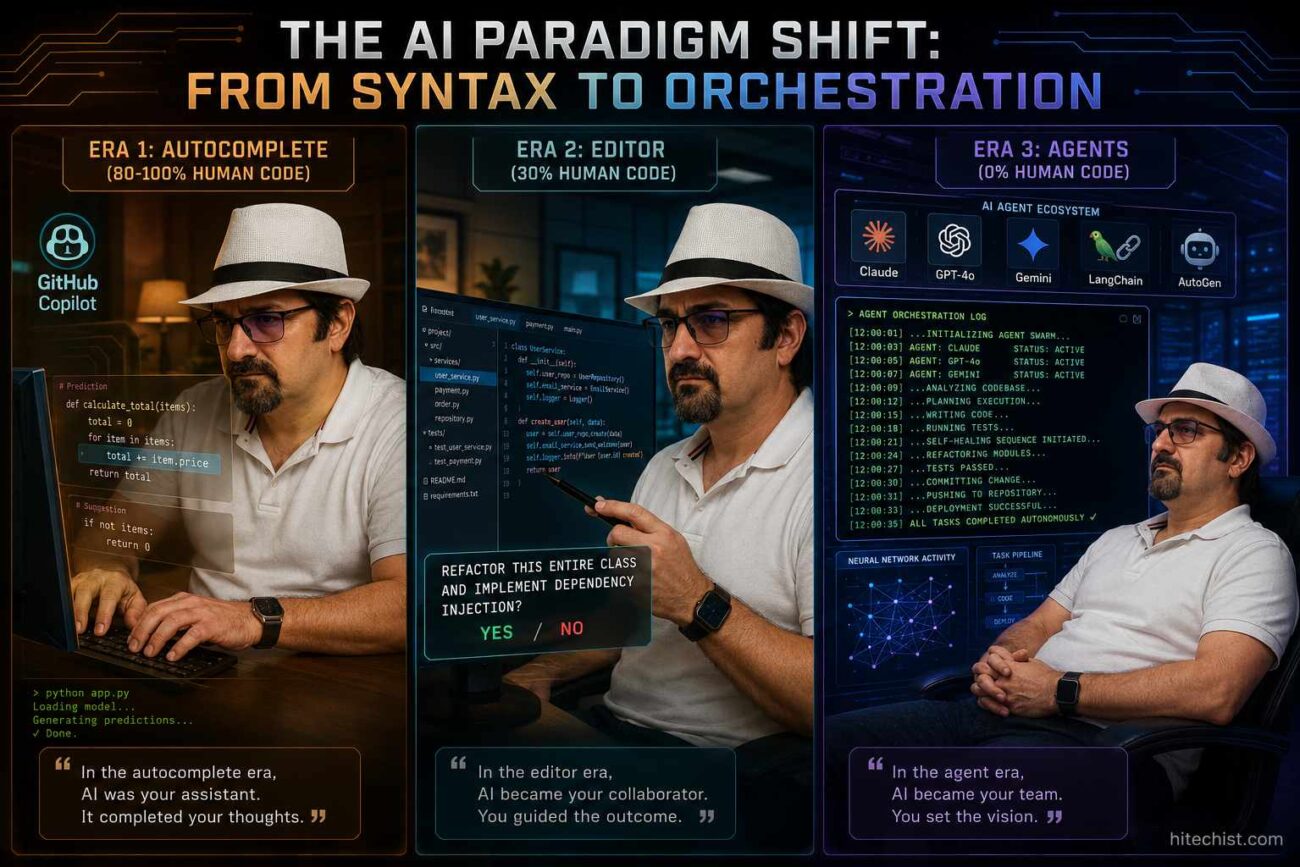
The transition hasn’t been a sudden leap, but rather a rapid evolution through three distinct phases:
- The Autocomplete Era: Tools like the early iterations of GitHub Copilot acted as incredibly smart typewriters. You wrote the logic, and the AI saved you from typing out boilerplate or remembering the exact syntax for a
reducefunction or aterraformmanifest. The developer was still fully in the driver’s seat. - The Editor Era: With the rise of AI-native IDEs, the dynamic changed. Developers started highlighting entire blocks of code and prompting the editor to “refactor this for better performance” or “add error handling.” The AI moved from predicting the next word to executing discrete, localized tasks.
- The Agent Era: This is where we are now (when I’m writting this). Autonomous agents operating directly in the terminal can take a prompt, write the code, run the tests, read the error logs, and iterate until the feature works. The developer’s role is shifting from hands-on creation to high-level supervision.
This shift brings a controversial question to the forefront of the industry: Do you still need to read the code?
As AI agents take over the heavy lifting of writing, the premium skill is no longer syntax memorization. It’s code review and system architecture. When an AI generates 500 lines of code in seconds, the human bottleneck becomes validation. Engineers are now tasked with ensuring that the generated code is secure, maintainable, and aligned with the broader business logic.
The best developers of tomorrow won’t necessarily be the fastest typists; they will be the most rigorous auditors. They will possess a deep understanding of system design, enabling them to spot the subtle, cascading architectures flaws that AI models still struggle to foresee.
The Divide: Speed vs. Scale
How developers adopt these tools depends heavily on their environment:
| Developer Profile | Primary Goal | AI Adoption Strategy |
| Enterprise Engineers | Reliability and Security | The Meticulous Auditor. They use AI to draft, but meticulously review every Pull Request. A hallucination in a large-scale system can cost millions, so human judgment is paramount. |
| Indie Hackers & Startups | Speed and Validation | The Vibe Coder. They embrace aggressive AI automation to ship MVPs in days rather than months. They are willing to fix bugs in production if it means getting to market faster. |
Programming isn’t dying; it is undergoing an abstraction. Just as we moved from punch cards to Assembly, and from Assembly to high-level languages like Python and JavaScript, we are now moving to natural language as the ultimate programming interface.
The engineers who thrive in this new era will be those who stop viewing AI as a threat to their syntax skills and start viewing it as an infinite team of junior developers waiting for their architectural direction.