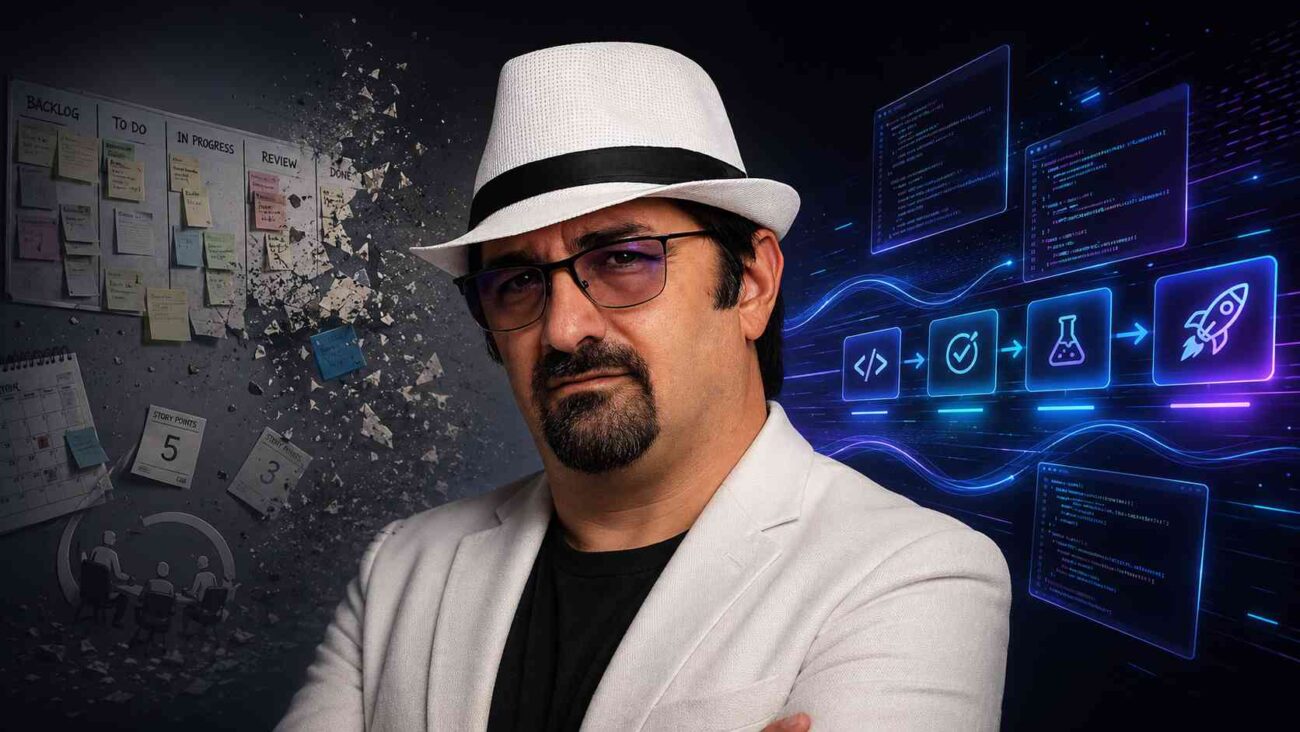
For years, software teams have worked in 2 to 4 week cycles: plan, backlog grooming, poker estimate, build, daily scrum, review, retrospective, repeat.
AI breaks that model.
When an AI coding agent can generate in minutes what once took days, the sprint is no longer accelerating work. It is delaying it. A team may spend two hours planning a task that takes 30 minutes to complete.
AI does not just make sprints faster. It makes the sprint itself increasingly obsolete.
Story points become unreliable when execution time changes radically depending on how well AI handles a task. A feature estimated as “complex” may be generated almost instantly, while a small change may still require extensive human review.
Meetings become equally difficult to justify. Planning, grooming, and estimation can consume more time than implementation.
Even the backlog changes. The problem is no longer a shortage of engineering capacity. It is a shortage of clearly defined work. AI can expose how much of a backlog is vague, outdated, or unnecessary.
What Replaces the Sprint
The better model is continuous pull.
Work is selected, scoped, generated, tested, reviewed, and deployed as soon as it is ready. Teams stop waiting for an arbitrary cycle boundary.
AI can also break large business goals into small, executable tasks on demand, reducing the need for manual backlog grooming.
The engineer’s role shifts as well. Humans become architects, reviewers, and quality controllers rather than primary code producers. Their job is to direct the system, evaluate trade-offs, and catch errors AI cannot reliably recognize.
Faster output creates new risks. AI can generate code faster than humans can review it, leading to reviewer fatigue, weak oversight, and technical debt. Teams need strict limits on work in progress and stronger automated guardrails.
Testing, security scanning, observability, and controlled rollouts must become part of the default workflow.
Metrics must change too. Velocity and story points matter less than time-to-value, reliability, adoption, and defect rates.
The future belongs to teams built around continuous flow, not rigid ceremonies.
AI will not reward companies that simply complete more work. It will reward those that make better decisions, validate them faster, and deploy safely.
The winners will not be the teams that sprint faster. They will be the teams that eliminate the starting block entirely.