

December 2024 marked a fundamental tremor in the technological landscape. With the release of OpenAI’s O1, followed swiftly by Gemini and DeepSeek in early 2025, the ground beneath the cybersecurity world officially shifted. The era of “Deep Reasoning” models has arrived, causing a profound fracture in traditional defense strategies. This isn’t just a seasonal shift in the weather; it is a seismic event where the adversary has gained a catastrophic operational advantage.
The New Fault Line: Single-Prompt Exploits
The conventional approach to attacking a system required patience, skill, and often “copiloting” with an AI model—a laborious, step-by-step guidance process to probe for weaknesses. Today, deep reasoning models have rendered that approach obsolete, opening a massive rift in defense.
Attackers now wield tools that move from vulnerability discovery to reliable execution of complex exploits with a single prompt. More alarming still is the emergence of autonomous, LLM-assisted worms that act as intelligent agents. These agents do not just find flaws; they adapt to the terrain. Whether the target environment is macOS, Windows, Linux, or an IoT device like a network printer, the AI crafts the specific malware required, exploits the flaw, and then creates chain proxies to maintain its grip on the network and continue its autonomous spread.
Collapsing the “Frankenstein Collage” of Security
For decades, Chief Information Security Officers (CISOs) built their structures on shaky ground using a disjointed mix of vendors: one provider for the firewall, another for Zero Trust Network Access (ZTNA), a third for load balancing, and yet another for VPNs. This fragmented architecture cannot survive this new magnitude of threat.
To protect against AI-driven agents, and to secure internal AI systems, a unified, solid foundation is now mandatory. Every component of the security stack must be inextricably linked. CASB, WAF, firewalls, and gateways must communicate instantly. Tech leaders are facing immense structural tension: they must integrate AI into their core systems to maintain competitive advantage, yet they must accept that these models are inherently unstable by design, susceptible to prompt injections, data leaks, and hallucinations.
Shoring Up the Defenses: The Fight Against Structural Failure
Despite the overwhelming stress on existing defenses, the cybersecurity industry is reacting by using AI to reinforce the infrastructure, matching the speed of the attacker.
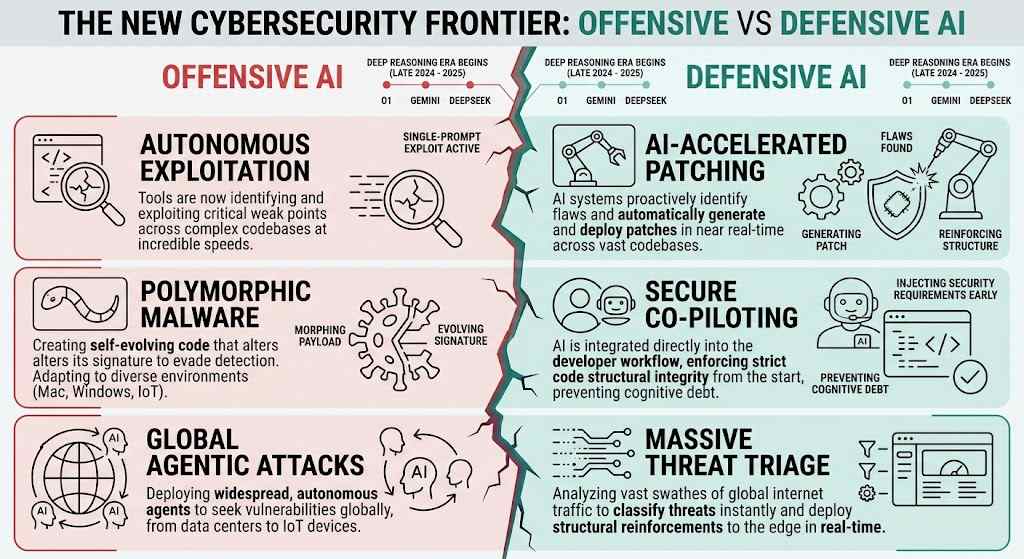
The Illusion of Solidity
There is a dangerous fallacy that relying on established “Frontier Models” provides structural integrity. While tech giants invest heavily in safety guardrails that refuse malicious requests, these supports are fundamentally fragile.
Jailbreaking these models (bypassing their alignment protocols to force them to perform forbidden tasks) remains alarmingly simple. A fortified model is not an impervious one. It is a solid structure only until an attacker finds the precise resonance needed to shatter it. Furthermore, the emergence of unrestricted open-source models generated through distillation complicates this new reality even further.
The evolution of artificial intelligence is an engineering marvel, but it has created a profound rift in how we must approach enterprise security. Trying to weather this shift is impossible; navigating this new reality requires building an entirely new, unified, and resilient foundation.
